2025: A big year for coherence
Looking back, 2025 was a big year for us at coherence.
Not only in a, “we shipped a million features” way, but in the sense that a lot of long-running work finally started showing up in the real world. Yes, we delivered big improvements to our tech and used that tech to help build multiplayer games, but we also supported major game launches with big player expectations.
Anybody working in the games industry knows it can be hard to keep your project a secret when you're so excited about it. It's the nature of what we do. Well, this was a year when we could finally speak about our projects and major developments, and we’re really proud of what we’ve accomplished.
We’re looking forward to being able to talk about some huge new games launching later this year but, for now, here are the highlights from 2025!
Vampire Survivors went fully online
In 2025 we could finally tell people we were building the online multiplayer for Poncle’s Vampire Survivors. What an incredible project.
Vampire Survivors is one of the most played indie games in the world and bringing it from local co-op to online play was not a small change. Poncle has had a great run with Vampire Survivors (and it’s far from over) and they’ve continued to add content to the game that required continuous tweaks and improvements to ensure the quality of the co-op experience could be maintained online.
There isn’t a lot of room for error when your game has so much traction.
We worked closely with Poncle to make that transition happen, and to test and validate gameplay tweaks that might make the gameplay even better for online play. At launch, we managed to navigate some unexpected platform challenges flawlessly, keeping them invisible to players. All thanks to our super flexible hosting systems and some really talented backend engineers.
For us, this mattered a lot because it proved, very publicly, that coherence works when and where it counts.
We’ll have more details to share soon about how coherence hosting tech helped us navigate that launch difficulty, but you can learn how we approached the project from a strategic development perspective now, here.
We shipped coherence 2.0
Every single feature, improvement, or fix in coherence 2.0 was the result of years of working with studios on real, shipping games. We learned so much and this release just drives our vision (to make multiplayer accessible to any developer) even further.
When coherence was founded, the idea of reinventing multiplayer development was about making it more accessible to any generalist game developer. We want to play more multiplayer games and we want to help connect people through games. This means making multiplayer development less fragile, less intimidating, and more predictable.
With coherence 2.0, we’ve really delivered on that dream:
- A Unity-native engine that has been hardened in production.
- Hosting options that let teams start small and adapt over time.
- Tooling that helps generalist developers understand what is really happening, instead of guessing (or praying).
Being able to make all of our internal tooling and experience available to anybody, at any experience level, feels very fulfilling. If you want the full breakdown of what changed, you can find it here.
We launched an indie-friendly pricing model
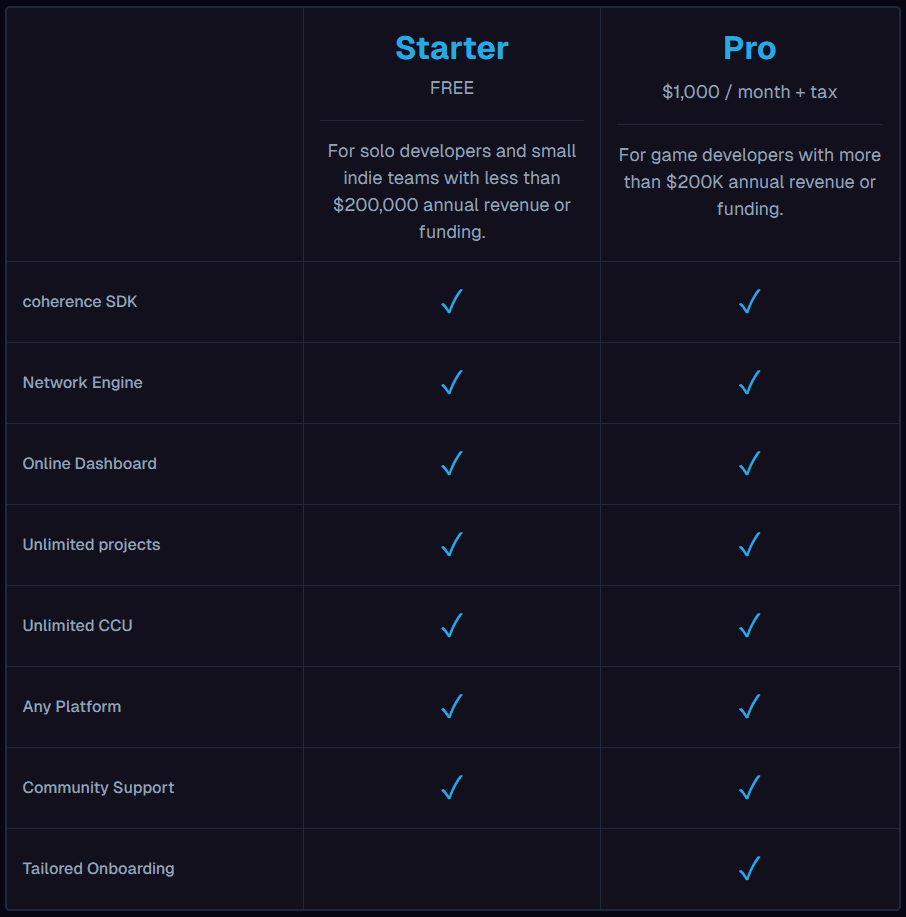
We knew that coherence 2.0 couldn’t just be about great new features and technical ease of use. It also needs to be easy to choose from a cost perspective.
We’ve spent enough time with developers to know that pricing can quietly kill ideas and creative motivation. If experimenting with multiplayer feels risky or expensive, teams either delay it or skip it entirely.
This one took a lot of thought, a lot of internal debate, and a lot of “this isn’t good enough!”
Our new model includes a free Starter Tier for smaller studios, a simple studio license for teams that have grown, and hosting costs that are flexible enough to fit any game or budget.
There are no CCU limits, no feature gates, and no penalties for games that aren’t succeeding.
We are very aware that no pricing model is perfect. But this one reflects how we want to work with developers: if your game is struggling, we are not trying to squeeze you and we certainly do not want pricing to be the reason it shuts down. If your game is succeeding, we’re happy to grow with you.
We’ve been getting excellent feedback from indies and small studios on this model, but we’re always hungry for more. Check out the full details here, then jump in the forum or set up a call if you want to discuss a project.
coherence joined Roundtable Interactive Group
In 2025, we finished a major acquisition, where coherence joined the Roundtable Interactive Group, backed by EMK Capital. The short version is this: our mission did not change, our product did not change, and our team did not suddenly disappear behind a corporate curtain.
What did change is our ability to think longer-term.
Joining RIG gives us access to more experience, more resources, and more shared infrastructure. It means we can support bigger projects, invest more deeply in the engine, and take on work that we would previously have had to say no to.
You can read more about the acquisition here.
Staying close to developers
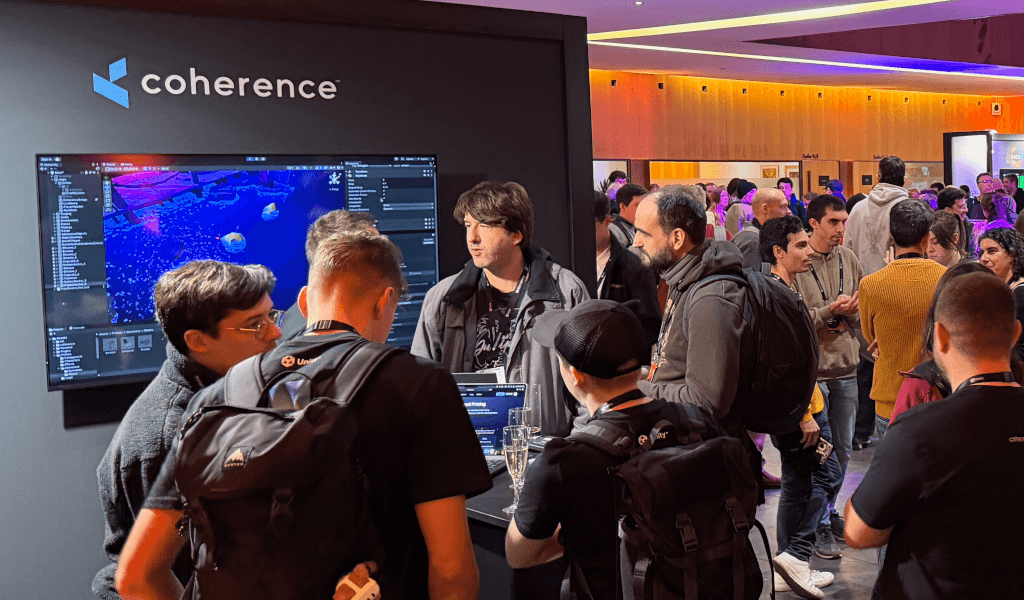
We travelled a lot in 2025, meeting a massive number of developers in person.
We were at GDC, Nordic Game, Develop Brighton, Gamescom, and Unite Barcelona, among others. Meeting devs in person is always great, they’re some of the most meaningful conversations and connections we have. We learn about new projects and explore how to make them real and we connect with new developers who haven’t thought multiplayer was possible for them.
We’re already locking in our event calendar for 2026 and things are quickly filling up. If you want to get in touch, do it! We can always find space in the calendar to chat about new multiplayer games.
Looking ahead to 2026
The work we did in 2025 sets us up well for what comes next.
In 2026 we’ll be supporting larger customer projects, expanding where and how coherence can be used, and continuing to invest in co-development work with studios that want hands-on help bringing multiplayer to life. Some of that work is already underway, even if it is not public yet.
We feel good about where coherence is headed and about the role we get to play in helping developers connect people through play. Thanks to everyone who shipped with us, tested with us, challenged us, or stopped by to ask hard questions this year.
We're excited for what comes next.
Written By