Physics Impossible: Bringing Heave Ho 2 online
Devolver wanted Le Cartel to make Heave Ho 2 more than just a good sequel, and that meant taking it online. Le Cartel had two big concerns: that the game's physics couldn’t survive the internet, and that they couldn’t replicate the couch co-op feeling that made Heave Ho so special. Here’s the story of how coherence solved both these problems to make Heave Ho 2 possible.
The ragdoll physics of the first Heave Ho already stretched the original Nintendo Switch to its limits, with a rope system tuned right up to the edge of what the hardware could handle. When Le Cartel, the studio behind Heave Ho and Mother Russia Bleeds before that, started asking around about online multiplayer for Heave Ho 2, the answer was the same every time.
"We had talks with other studios and they all told us: the game relies strongly on physics. It's four players. It's really real time. You are a small team. It will be complex," said Guillaume Levieux, the programmer behind Heave Ho 2. "We were kind of convinced it was not possible."
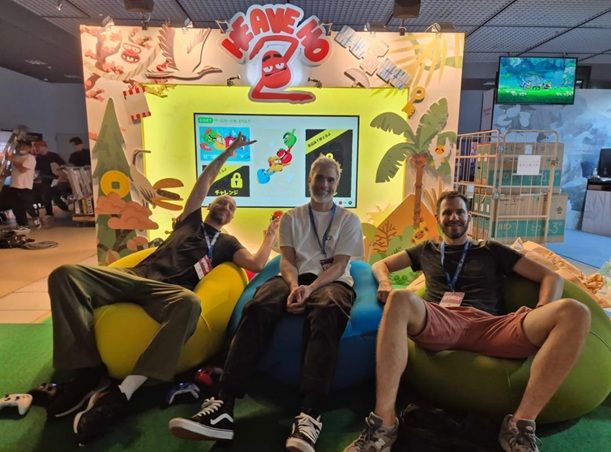
A three-person studio
Le Cartel is small on purpose. Guillaume is the Programmer. Frédéric Coispeau is the Creative Director. Alexandre Muttoni is the Art Director. That's it. That’s the team.
The first Heave Ho, now closing in on 1 million copies sold came out of a 48-hour game jam that wasn't supposed to go anywhere. Le Cartel had a meeting booked with Devolver Digital to pitch a completely different game but they ended up showing the game jam prototype for Heave Ho, instead.
Devolver signed on for Heave Ho. It shipped in 2019, just ahead of COVID, and found its audience on couches and streams: a game about grabbing your friends' hands and swinging across platforms while everything wobbles.
"We were a small team, there was only one programmer," Guillaume said. "We thought online online multiplayer would be technically very complicated. Plus., Heave Ho shines when you're playing with friends on the couch. So we gave up the idea and just focused on local multiplayer."
More than v1.5
Then came Heave Ho 2. It hit alpha roughly a year and a half into production, with Devolver still looking for a reason for the sequel to be more than just "a very good 1.5."
"Online was a pretty regular ask from players of the first game," said John Bartkiw, CTO at Devolver. "It can be hard to find time to get together with friends in person, so online opens up the ability to enjoy the game with friends you normally can't get together with. It's also a big marketing point. The content for the sequel is amazing and unique compared to the original, but having a major new feature alongside it makes it an easier differentiator."
But that’s exactly what every other developer told Le Cartel was impossible.
Le Cartel was already running a small team and Devolver did not have the extra engineering staff to take the work off their plate. John explains, "We don't have a lot of dedicated engineering resources to throw at bigger technical needs. Finding an outside partner was key."
Le Cartel were not optimistic. That's when John decided to bring in the coherence team: "We wanted Le Cartel to focus on the gameplay and their creativity, rather than a new layer of technical challenges that would distract from their goals."
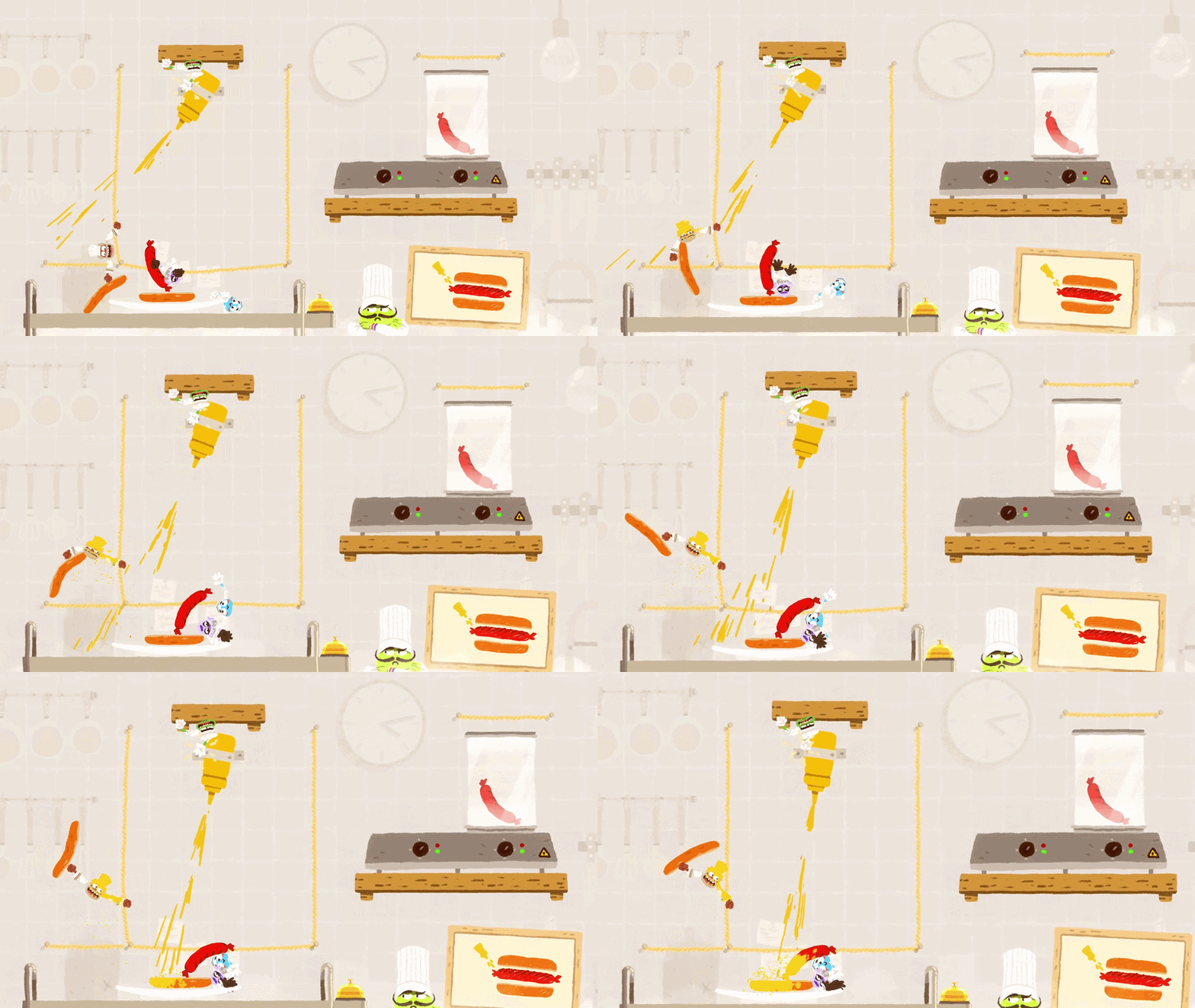
The kitchen level
Team coherence built two proofs of concept to convince Le Cartel that online multiplayer was possible. Cary Brisebois (The Simpsons: Hit & Run, Crash Bandicoot: Crash of the Titans) built the first prototype alongside Benito Gangoso Rodríguez (Crysis franchise, The Climb, and Ryse: Son of Rome). The goal was simple: prove the idea wasn't dead on arrival before anyone committed more time and investment.
Guillaume showed up to the first online playtest expecting the worst, and for his sceptical colleagues to be proven right.
"We were really just looking at: is it playable? Can we actually play this?"
It was perfectly playable.
"I cannot describe the relief I felt," Guillaume remembers.
But one success wasn't enough to undo months of skepticism and being told this couldn't work. So for the second proof of concept, Le Cartel handed over the most developmentally challenging level they had created: the kitchen. It was extremely complex, including ropes, cooking equipment, and multiple ingredients flying between players. It was physics interactions stacked on top of each other.
"We chose it because you have many interacting objects, and the most complex objects in the game are in the cooking levels," Guillaume said. If this level worked online, anything would.
John Bartkiw, Devolver's CTO, played it too. It was his first time trying Heave Ho online, and he was convinced:
"The confidence came from the early proof of concept. For me, code speaks. Saying you can do something is one thing, but seeing running code, even in an early state, gives me more confidence than a shiny PowerPoint deck."
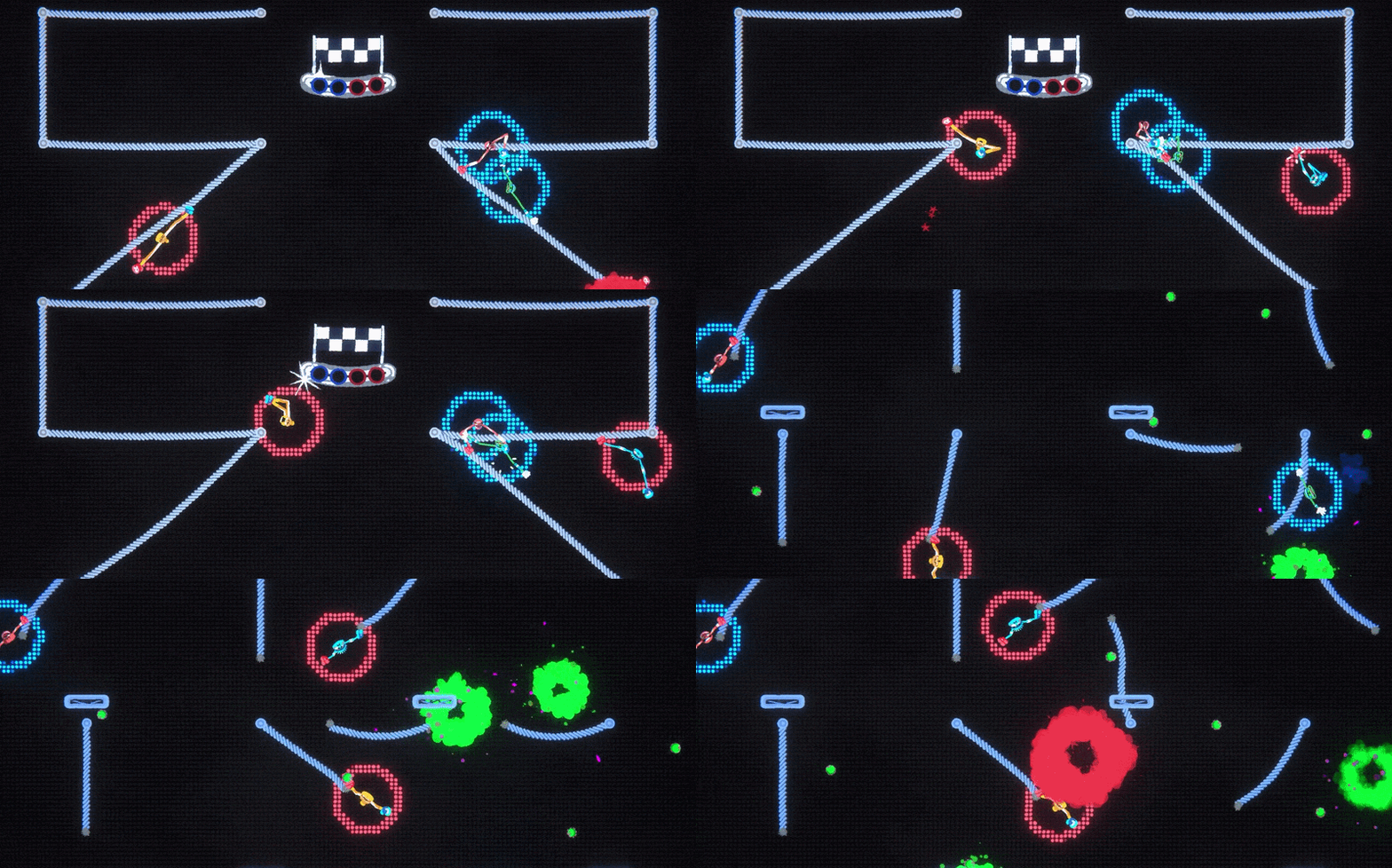
Heave Ho 2 has... a lot of ropes
Some levels have fifty or sixty ropes, each with dozens of physics nodes. Syncing every node across four players at full rate would flood the connection. The fix was two-fold: first, coherence syncs only a few key nodes and lets the local physics engine interpolate the motion, while dynamically adjusting update rates, slowing down when ropes are off-screen or untouched, and ramping up to full sync the moment a player grabs on.
Position and rotation data got compressed too, built for the game's 2D reality instead of a full 3D transform, cutting the data per node by roughly 60%.
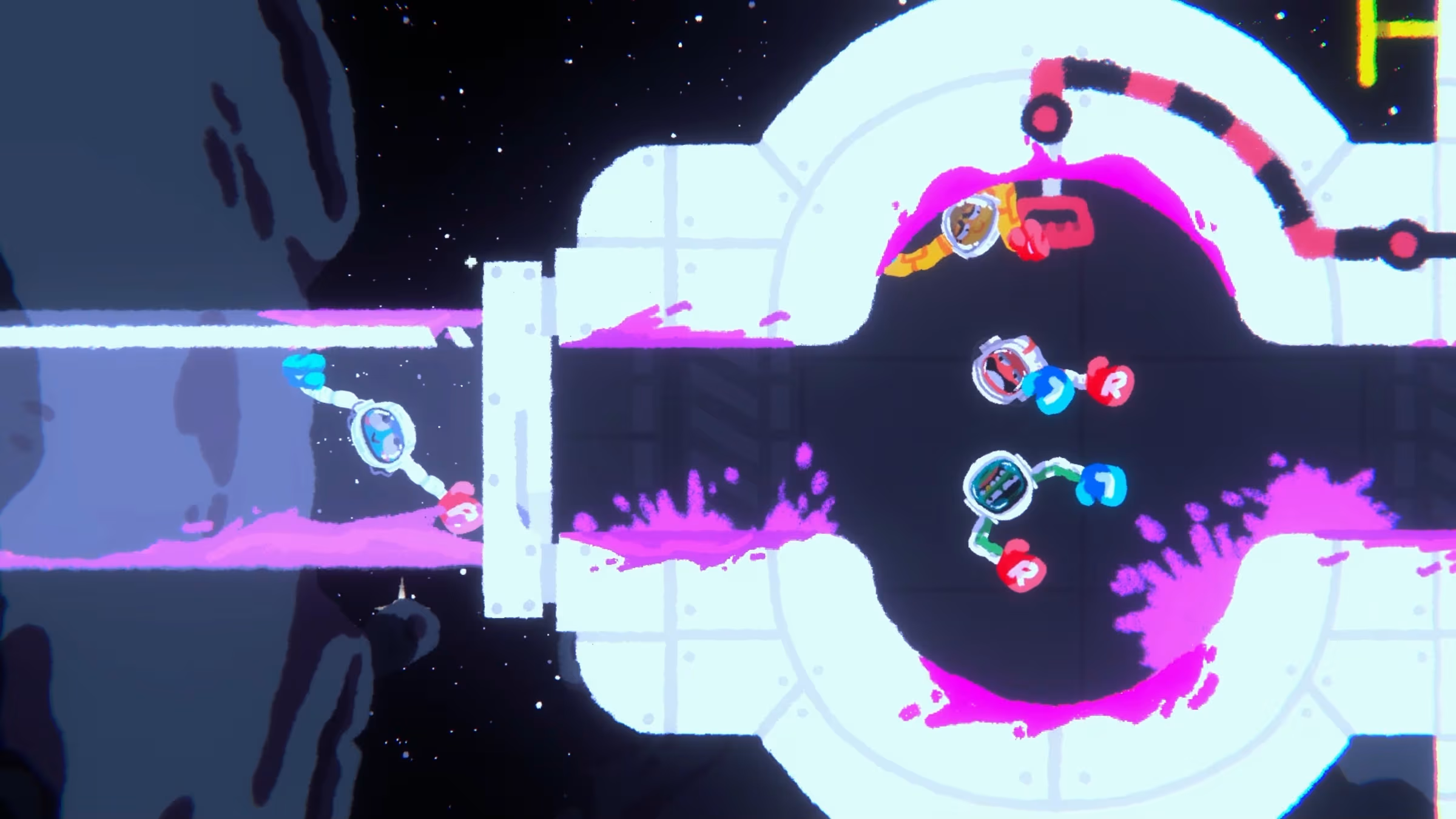
Ropes weren't the only physics problem. One level snaps three or four players' characters together into a single connected shape, while each still controls their own arms. Another level has four players sharing thruster controls on one ship, all applying force to the same object at once. Both have a similar challenge: when multiple players affect the same object at the same time, whose physics win? coherence’s authority model answers that before it becomes a problem. One client holds authority over the whole simulation, computes what actually happens, and then sends the result to everyone else. There’s only ever one version of events, instead of multiple competing events.
Teleporters created a different challenge. coherence’s interpolation system smooths movement between network updates, which works well for continuous motion but it doesn’t know the difference between a fast move and an instant jump. A character reappearing on the other side of a level got smoothed the same way, and would visibly slide in at full speed instead of just appearing. To solve this, Benito took advantage of atomic entity updates to implement teleport detection, allowing client instances to temporarily disable interpolation for a single frame. This ensured characters and other objects alike snap cleanly into their new position instead of visibly sliding across the map.
Characters don't send full animation state over the network either. A handful of synced values, like whether a character is currently happy or underwater, drive the animation locally on every client. Fewer values, less traffic, same result.
A physics-heavy game doesn't have to be a bandwidth-heavy one. Let the simulation do the work instead of the network.
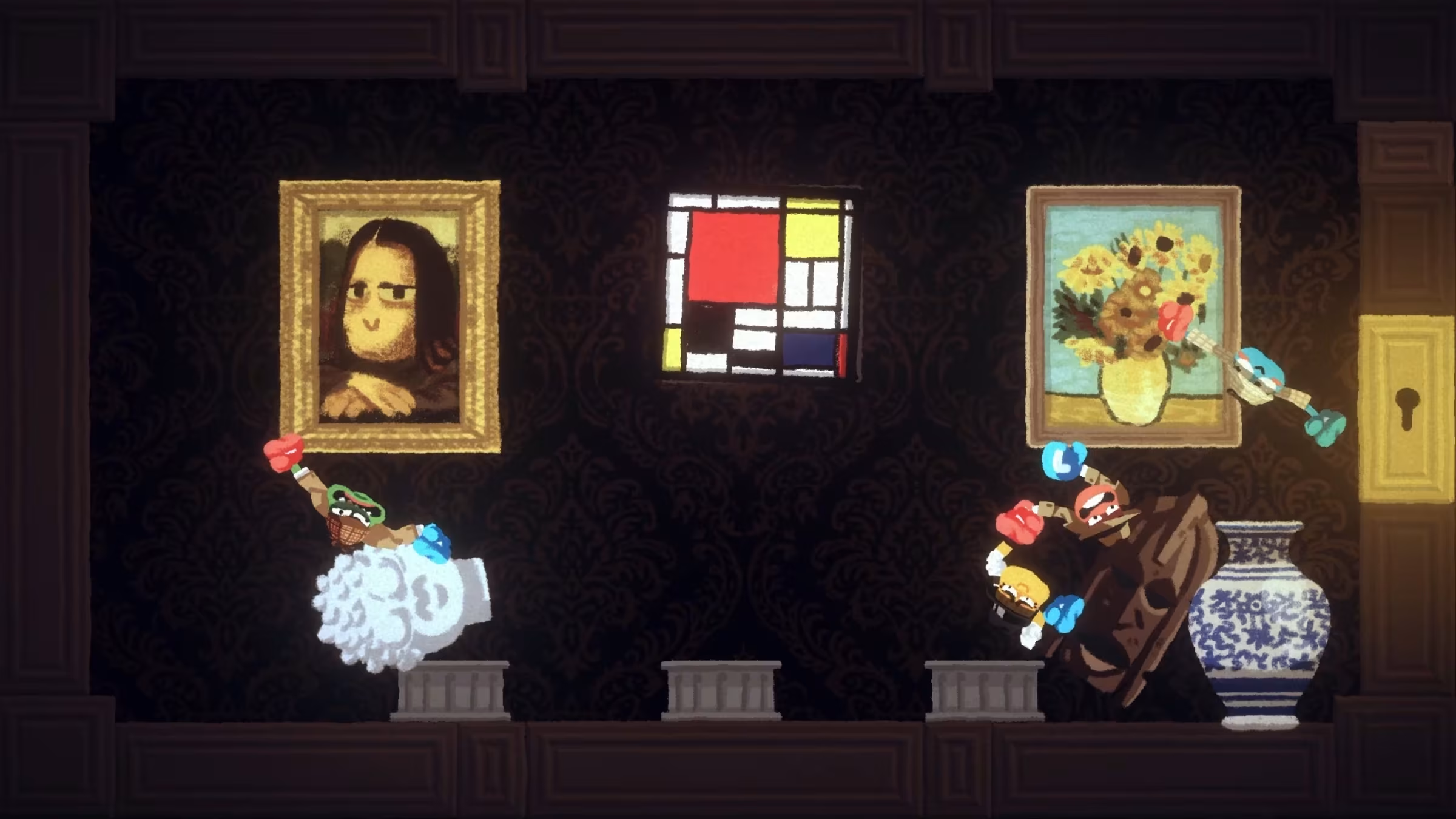
Multiplayer is about the people. Not the match.
Ask Benito what took the longest on this project, and it isn't the physics. It's the menu.
Most online games treat the menu as a waiting room. You join, play a match, and when it ends everyone scatters, maybe to a Discord call, maybe not. The connection is to the match, but always to other players.
coherence exists because we believe the real value of multiplayer isn't just about the game, it's about connecting players and enabling developers to do this in whatever crazy or creative way they can dream up. Heave Ho was built entirely around the couch: grabbing your friend's hand, deciding what to try next, and staying in the room together between rounds. Le Cartel and Devolver didn’t want to just "let people play online." They wanted to let them connect the way they would on a couch.
"It's like replicating the local experience of playing locally together, but online," Benito said.
So every player's screen follows the host, the same way you'd all be looking at one TV. A group doesn't disband after a match; they move from adventure levels to versus rounds and back to the menu, everyone together, not four separate lobbies rebuilt from scratch each time. Levels unlock as a shared pool across the group. Characters and achievements stay personal to each player. Small details, which make sense when you understand what the menu is actually for.
"We had to revisit the macro design," Guillaume said. "It was chaos. We looked at other games, like Overcooked, for inspiration on the flow."
Two months later, it wasn't chaos anymore. It was the couch-feel of the original Heave Ho, rebuilt online, allowing players to decide what to play next together. Now, multiplayer truly did extend beyond the match.
Built alongside, not after
Benito was fully embedded with Le Cartel’s three-person team, and adapted to their processes.This meant no branches, no pull requests, no code review, just everyone pushing straight to one shared main branch. Adjusting to something this unconventional turned out to be an easy problem to solve.
The solution wasn't the process, though. It was the timing. Le Cartel was still actively building Heave Ho 2, both new levels and new mechanics, while Benito networked the completed levels.
"We just worked on things as soon as they were done," Benito said. "_They'd tell me, ‘we're done with this adventure, you're free to go in.’ _" Neither team blocked the other, Le Cartel didn't pause content development, and coherence didn't wait for a finished game to start networking it.
Daily updates went out on Slack instead of formal reviews, and Le Cartel always had a direct line "We could always ask. It was much better to have Benito available when we had issues. I could just DM a question and have feedback very quickly," Guillaume said.
Sloan Kelly, a second coherence engineer, joined later once more modes were added than originally scoped. This is another benefit to working with coherence: being able to pull in extra developers to add capacity or specific skill sets.
In the end, the ability for Cary, Benito, and Sloan to seamlessly integrate with Le Cartel’s development process meant nobody felt bottle-necked or had to slow down. Le Cartel could focus on their core area while trusting that the coherence team would make multiplayer magic.
"Big shout out to Benito," Guillaume said. "You're very lucky to have him. He is very, very good. He's always making things perfect."
The end is just the beginning
Every studio that Le Cartel asked said this game couldn't work online. But coherence’s technology and expert team proved it was possible. What nobody expected (not even us) was that there was an even bigger, more important challenge, and that was keeping the game's soul intact: making players feel like they were back on the couch. We’re proud to share that we helped to solve that too.
What’s next? Well, coherence technology has made new gameplay modes possible, modes Le Cartel is still experimenting with and testing, so watch this space. Guillaume reflects, "Working with the coherence team has helped us make something we wouldn't have been able to make if we didn’t have coherence."
Heave Ho 2 is available right now on Steam, Nintendo Switch, and Nintendo Switch 2.
Follow Le Cartel on Instagram and LinkedIn.
coherence is a multiplayer networking engine and co-development studio built by a team of veterans from DICE, CD Projekt Red, Crytek, Ubisoft, Blizzard, and Playdead. Studios use coherence to add or build online multiplayer in Unity without rewriting their games. For more, visit coherence.io.
Written By